Wave Technology Group is a company my partners and I recently engaged through the University of Chicago Hospital's Pediatric Epilepsy Center. Wave was launched by Sam Cinquegrani, a local Chicago entrepreneur who cut his teeth is software developing object-oriented platforms for institutional clients such as the City of Chicago and the Chicago Board of Options Exchange (CBOE) and Fortune 100 corporations, namely JP Morgan and Mitsubishi.
As a student of politics and a passionate believer in globalization, I have become increasingly frustrated by the sense that we, the next generation of world leaders, have been completely marginalized by selfish and unimaginative lawmakers in capitols around the world. It is my hope that this blog can serve as a forum for young, ambitious and articulate men and women who get it. What kind of world do you want to inherit?
3/24/2010
The American National Broadband Plan on Health Care: Opportunity in Abundant Supply
Wave Technology Group is a company my partners and I recently engaged through the University of Chicago Hospital's Pediatric Epilepsy Center. Wave was launched by Sam Cinquegrani, a local Chicago entrepreneur who cut his teeth is software developing object-oriented platforms for institutional clients such as the City of Chicago and the Chicago Board of Options Exchange (CBOE) and Fortune 100 corporations, namely JP Morgan and Mitsubishi.
2/08/2010
Federal Telemedicine News: $125 Billion Budget Request
Monday, February 8, 2010
$125 Billion Budget Request
Eric K. Shinseki, Secretary of the Department of Veterans Affairs appeared before the House Committee on Veterans Affairs on February 4th to discuss the President’s VA budget request for FY 2011. The President’s budget provides $125 billion in 2011 which is almost $60.3 billion in discretionary resources and nearly $64.7 billion in mandatory funding.The Secretary reported that in December 2009, the VA successfully exchanged electronic health record information in a pilot program between the VA Medical Center in San Diego and a local Kaiser Permanente hospital using the Nationwide Health Information Network. During the second quarter of 2010, DOD plans to join the pilot and there are plans to add additional Virtual Lifetime Electronic Record health community sites. The VA has $52 million available in IT funds in 2011 to continue the development and implementation of this priority.
The budget provides $51.5 million to use for medical care in 2011, which is an increase of $4 billion or 8.5 percent over the 2010 level. In 2011, the budget provides $2.6 billion to help meet the needs of veterans who have served in Iraq and Afghanistan.
The FY 2011 budget also includes funding to treat new patients resulting from the recent decision to add Parkinson’s disease, ischemic heart disease, and B-cell leukemia to the list of presumptive conditions for veterans with service in Vietnam.
The VA’s 2011 budget includes $250 million to strengthen access to healthcare for 3.2 million enrolled veterans living in rural and highly rural areas. Plans are to provide new rural health outreach and delivery initiatives and to expand the use of home-based primary care and mental health services.
The VA intends to expand the use of cutting edge telehealth technologies and would like to invest in $163 million in 2011 for home telehealth to take advantage of the latest technological advancement in healthcare delivery. The VA’s home telehealth program cares for 35,000 patients and a recent study found that patients enrolled in home telehealth programs experienced a 25 percent reduction in the average number of days hospitalized and a 19 percent reduction in hospitalizations.
According to the Secretary, the Department’s IT operations and maintenance program supports 334,000 users situated in 1,400 healthcare facilities, 57 regional offices, 158 national cemeteries around the country, plus the IT program maintains 8.5 million vital health and benefit records for veterans. The FY 2011 budget provides $3.3 billion for IT, which is the same level of funding provided in 2010.
The IT resources requested would fund IT to process education claims, to help the Financial and Logistics Integrated Technology Enterprise project replace outdated technology, further develop the paperless claims processing system, and continue to develop the VA’s EHR system for $342.2 million.
Posted by Carolyn Bloch at 7:24 AM
1/28/2010
New Physician Adoption Statistics « Health IT Buzz
New Physician Adoption StatisticsTuesday, January 26th, 2010 | Posted by: Dr. David Blumenthal | Category: ONCThe CDC recently released its latest report on the adoption of electronic health records/electronic medical records (EHR/EMR) amongst office-based physicians from the National Ambulatory Medical Care Survey. As a physician who trained and initially practiced in a time where nearly every order, record, and prescription was paper-based, the results are striking to me.
The final results for 2008 show about 16.7 percent of physicians reported having systems that met the criteria of a basic EHR/EMR system, and about 4.4 percent reported that of a fully functional system. Preliminary results for 2009 show about 20.5 percent reported having systems that met the criteria of a basic system, and 6.3 percent reported that of a fully functional system.
Combined basic and fully functional statistics for the last 3 years are as follows:
- 2007 – 17%,
- 2008 – 21%,
- Preliminary 2009 – 27%
The latest figures, especially the preliminary 2009 numbers, suggest that the pace of adoption of HIT is quickening. We expect that the federal government’s health IT strategy will accelerate the pace even further by systematically addressing the obstacles physicians experience in adopting health IT (see below).
HOW THE US FEDERAL GOVERNMENT IS SUPPORTING HEALTH INFORMATION TECHNOLOGY USE
The Obama administration believes health information technology (HIT) is a critical component of efforts to improve the quality, efficiency, and value of care delivered to patients. The Office of the National Coordinator for Health Information Technology (ONC) is leading the administration’s efforts to support the thoughtful application of HIT. Cognizant of the numerous barriers that exist to making health IT work in real-world settings, the ONC is administering programs to systematically address these barriers:
OBSTACLE INTERVENTION FUNDS Financial Resources Medicare and Medicaid Incentive Program: incentive payments to “meaningful users” who use health information technology to improve value and efficiency of care delivered to patients Technical Assistance Regional Extension Centers: Up to 70 regional extension centers (REC) will help providers through the process of selecting and implementing electronic health records $643 Million The vision of a health care system that uses information technology to improve the value of services to patients is inching closer towards reality.
The ONC is committed to making the transition to electronic health records successful for every physician and hospital.
I hope you will share the experiences, challenges, and success stories that belie these encouraging statistics.
– David Blumenthal, M.D., M.P.P. – National Coordinator for Health Information Technology
National Coordinator for Health Information Technology, David Blumenthal, MD, blogs about physician adoption of electronic health records, a subject on which he has long been the go-to authority. With merely 27% of physicians deploying a fully functional EHR, its now up to Blumenthal to find real solutions and strategies for stimulating widespread adoption. So far his ideas and initiatives have been promising.
1/27/2010
Video Conferencing saving lives in Irish Hospitals
Claire O’Connell in the Irish Times has an interesting article on how a stroke patient at the Midland Regional Hospital in Mullingar received urgent and potentially life-saving treatment on Sunday after a consultant at another hospital used the RP-7 (the “Remote Presence Robot” pictured below) to assess her remotely and prescribe clot-busting medication.
“The patient, who had a stroke just after noon, was collected by ambulance and was at the Midland Regional Hospital in Mullingar by 1.30pm. She was assessed by Prof Des O’Neill at Tallaght Hospital using the RP-7, which also allowed him to talk with her, examine her scans and discuss treatment with members of the medical team in Mullingar. The patient was on clot-busting medication by 2.40pm and her condition improved in half an hour”
Prof O’Neill commented on this first with a reminder of the short time window there is for putting suitable patients on potentially life-saving thrombolytic drugs; “The key challenge is to get people to have their clot-busting drug within three hours of a stroke.”
This entry was posted on Wednesday, January 20th, 2010 at 10:42 am and is filed under Uncategorized. You can follow any responses to this entry through the RSS 2.0 feed. You can leave a response, or trackback from your own site.
Personal Health Systems: A View from Across the Pond | Chillmark Research
The European Union (EU) is struggling with many of the same healthcare issues as the US, aging population, ever increasing costs of care and the need to move to new modalities of care. This is one of the key take-aways from a recent EU-sponsored report: Reconstructing the Whole: Present and Future of Personal Health Systems. This report looks at the present state of Personal Health Systems (PHS), assesses gaps (technology, process & culture) and lays out what is required to meet the “promise of PHS” by the year 2020.
The report takes a very broad brush to what is PHS including IT, sensors, diagnostics, and drug development (personalized). This is a big report at some 240pgs and unfortunately is one of those reports that is all too big and all too academic to be useful to the average healthcare wonk. But tucked within this future, sitting-on-the-bookshelf and collecting dust report are a couple of tidbits worth mentioning.
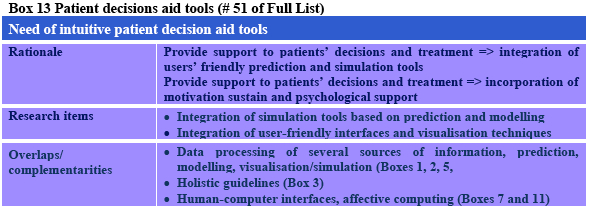
On pages 79-86 are a series of gap analysis tables (20 in all) addressing a wide range of areas associated with PHS. Below is the Table addressing Patient Decision Aid Tools.
While the above gap analysis tables are instructive, they are not terribly “deep” and at times come across as superficial – thus would make good fodder for a “high-level” presentation to a less informed audience.
Arguably the best Table is found towards the end of the report titled: Six Domains of Implementation Gaps.
The table clearly lays out what are the future challenges to broader adoption and use of PHS. The key take-away here is the surprising similarity between the US and its EU counterparts in the deployment and use of PHS, despite what are very different healthcare system models. Which raises the question: Will such uber-players in the Personal Health Platforms (PHP) market, e.g., Dossia, Google Health and HealthVault create the systems and platforms required to support PHS data requirements? HealthVault’s move into international markets, (Canada and Thailand) signal yes, but will providers, payers and ultimately consumers join in?
Still more questions then answers at this early juncture in the development of consumer-focused systems and platforms. But there is a ray of hope in the global commonality of challenges faced that will lead to increasing attention and subsequently resources dedicated to bridging the gaps, addressing these challenges to create more effective and efficient care delivery models.
Possibly related posts: (automatically generated)
Chillmark Research does some very nice digging for useful learnings to be gleaned from an EU-sponsored report on the present and future of personal health systems. The second chart in particular does a great job of outlining the barriers to the establishment of a wholly unified personal health system.
Federal Telemedicine News: MHS IM/IT Plan Approved
MHS IM/IT Plan Approved
The Military Health System Information Management/Information Technology Strategic Plan for 2010-2015 has been approved by the Senior Military Medical Advisory Committee. Leaders from the Army, Navy, Air Force, Health Affairs, TRICARE Management Activity, Joint Staff, Joint Task Force National Capital Region Medical, and the MHS Office of the Chief Information gathered last summer for a series of workshops to develop the plan.While there have been strategic planning initiatives that have guided key priorities throughout the last ten years, this new effort by IM/IT leadership across the services, is the first formally approved plan since 1999.
The plan’s ten IM/IT goals that the Military Health Service (MHS) will focus on over the next five years are to:
• Provide rapid, affordable, secure delivery, and life cycle support for IT products and services
• Provide a comprehensive longitudinal EHR for all beneficiaries and care settings
• Implement a governance structure and process to enable effective and efficient use of resources
• Enhance enterprise intelligence through the use of enterprise tools, data, and services
• Advance the MHS personalized health agenda so that patients would have electronic access to their own records, have virtual visits, and be able to refill prescriptions online
• Advance IT interoperability using health, operational, and functional partners to create an accessible and complete virtual lifetime electronic record
• Show how the flow of funds from programming to execution can improve using better cost estimating methodologies
• Establish an innovation lifecycle management process to align IT innovation with MHS strategy
• Improve human capital management by having the right people with the right training and experience on the right job
• Develop processes, guidance, and standards to develop and integrate distributed services and applications so that time and money spent on products can be delivered rapidly and with a minimum amount of modificationIn total, the planning team drafted 13 unique action plans and 14 performance measurements to define specific activities, deliverables, and milestones. In the months ahead, the IM/IIT strategic planning team will work with the action plan teams across the MHS and then draft updates, review the IM/IT measures, and determine if and how these measures should link to the broader MHS Value Measures dashboard.
For more information, go to www.health.mil/mhscio/governance.htm.
This would be a great action plan for innovating/improving any health system, from the military to local and regional providers. Hopefully this crosses the president's desk and he adopts some of the major action items to his own health reform agenda. These are the major things that need to be addressed which will have the greatest impact on the health care industry.
1/23/2010
Unemployment Rate Increased in 43 States in December
From the BLS: Regional and State Employment and Unemployment Summary
Regional and state unemployment rates were generally higher in December. Forty-three states and the District of Columbia recorded over-the-month unemployment rate increases, four states registered rate decreases, and three states had no rate change, the U.S. Bureau of Labor Statistics reported today. Over the year, jobless rates increased in all 50 states and the District of Columbia.
...
Michigan again recorded the highest unemployment rate among the states, 14.6 percent in December. The states with the next highest rates were Nevada, 13.0 percent; Rhode Island, 12.9 percent; and South Carolina, 12.6 percent. North Dakota continued to register the lowest jobless rate, 4.4 percent in December, followed by Nebraska and South Dakota, 4.7 percent each. The rate in South Carolina set a new series high, as did the rates in three other states: Delaware (9.0 percent), Florida (11.8 percent), and North Carolina (11.2 percent). The rate in the District of Columbia also set a new series high (12.1 percent).
emphasis addedClick on graph for larger image in new window.
This graph shows the high and low unemployment rates for each state (and D.C.) since 1976. The red bar is the current unemployment rate (sorted by the current unemployment rate).
Sixteen states and D.C. now have double digit unemployment rates. Indiana, Missouri and Washington are all close.
Five states are at record unemployment rates: South Carolina, Florida, North Carolina, Georgia and Delaware, and several other states are close.
Privacy & Security of Personal Health Information | Chillmark Research
On Saturday, Jan. 10th, I’ll be moderating a panel at the Consumer Electronics Show’s (CES) Digital Health Summit. The distinguished panel that includes executives from Dossia, Kaiser-Permenante, Microsoft and Walgreens will address the topic: Who Will you Trust with Your Health Data?
In preparation, I have been doing some research on the subject and following are a few data points for consideration:
Since April 2003, HHS’s Enforcement Office has handled over 9,666 cases that required some form of enforcement/corrective action regarding HIPAA privacy and security violations of Personal Health Information (PHI). That works out to over 1,200 cases a year.
In 2009, PrivacyRights.org reports that there were 46 breaches of PHI representing nearly 80M records. Note that 76M of those records were from the VA that inadvertently sent one of its RAID drives out for repair without cleansing it of those 76M records of veterans. If you can’t trust the government to keep your PHI safe, who can you trust?
Subtract the VA outlier and you get about 4M individuals who had their PHI breached in 2009 across 45 documented incidents or about 89,000/breach. That’s a lot of compromised records!
Also in May of 2009 we saw the Virginia Health Data, Dept of Health Professionals get hacked in which 531,000 individuals PHI were compromised and held ransom by the hackers for a cool $10M.
And let us not forget CVS who was fined $2.25M for sloppy disposal of prescription records. No one has any idea as to how many individuals may have been compromised in this blunder by a major pharmacy chain.The scary thing about the above is that these numbers represent documented/reported cases of data breaches and it would be easy to argue that the actual number of breaches that occur in a given year is quite a bit higher (let’s remove the 76M records in the VA breach as that really is out there).
This all raises the question:
If organizations like the VA, the Virginia Health Data, Dept. of Health Professionals and some of the most prestigious hospitals in the country can’t keep PHI safe, who can?
Which logically leads to the next question…
Is there any true, fool-proof way to insure absolute privacy and security of PHI that is held by a covered entity, business associate or even an organization like Microsoft or Dossia acting on behalf of the consumer?
Yes, there are strong passwords, yes, data can be encrypted on a server but for just about every barrier thrown up, hackers have found a way to break in. Also, beyond just hackers, what is surprising is that a number of the PHI breaches in 2009 were done by employees who were then selling such data to others, such as ambulance chasing lawyers and tabloid magazines.
Which leads me to conclude…
Maybe the belief in absolute privacy and security of PHI is a fallacy.
As we move to digitize PHI through the adoption and use of EHRs by physicians and hospitals it is inevitable that we will see more breaches. Hopefully, the benefits that we, as a nation and citizens, accrue from the adoption and use of such digital records to better manage our health and coordinate health among our healthcare team will far outweigh the risks we will be taking in the potential compromise of our PHI.
Possibly related posts: (automatically generated)
1/01/2010
Billionaire Doctor Puts His Money Where His Mind Is... - Connected Care Solutions
Patrick Soon-Shiong elaborates in this CNBC feature on his ambitious vision and $1Billion philanthropic commitment to build a true naitonal Public HealthGrid.
Boldly, and brilliantly IMHO, Soon-Shiong asserts that we need to stop obsessing over advances in genomic, biotech and nanotech R&D and recognize that health systems, technology parks and even most academic research labs are ill-equipt to discover anything "meaningful" from this deluge of random data. It will be "mathematicians, physicists and computer scientists" that Dr Soon-Shiong believes hold the key to unlocking the greatest potential value for patients, physicians, regional providers, public health agencies and society at large.
The politician inside me hears Dr Soon-Shiong's vision to be a blueprint for sowing the seeds of a hyper-modern renaissance movement in America. By using "team science" to engage the greatest minds from every scientific discipline in one unified pursuit of a wickedly complex problem, Patrick may have unwittingly stumbled onto the secret formula for reshaping the very fabric of society!!
Public Health Informatics Institute | phConnect.org
phConnect is a web-based, interactive, collaboration platform created for public health professionals and those interested in public health to meet, share expertise, and work together on advancing public health. phConnect has been created to foster collaboration and communication across PHIN CoPs, the larger public health community, the health informatics community, and with other partners.
Public Health Information Network (PHIN) | Communities of Practice - CDC.gov
Welcome to the PHIN Community!
Communities of Practice (CoPs) are working to strengthen the Public Health Information Network (PHIN) as members collaborate, share, and focus on issues prioritized by the PHIN Community. The PHIN Community provides a participatory environment for members to learn, share expertise, and develop informatics solutions to improve public health’s capacity to use and exchange information electronically. PHIN CoPs are now collaborating on phConnect.org.
![]()
Communities of Practice are open to everyone, easy to join, and your level of commitment is up to you. Based on the feedback received from public health and information technology partners, a collaborative approach toward implementing PHIN is needed. CoPs provide that collaborative framework, enabling PHIN members to work together to identify and leverage best practices and standards for public health, information technology, and informatics as they relate to PHIN. Your involvement in a PHIN CoP will not only help set PHIN priorities, but also assist in strengthening and shaping the future of PHIN.
Your feedback will help expand and improve the PHIN CoPs. Please provide comments or feedback by completing the form on the Contact Us page, or by sending an email to phin@cdc.gov. To learn more about existing PHIN Communities of Practice, visit here. To Join a CoP, please complete the online form here.
Distributed Systems Laboratory at UChicago | Main Page - CSWiki
Distributed Systems Laboratory (DSL) at University of Chicago
The DSL group at University of Chicago's Computer Science Department and lead by Dr. Ian Foster conducts research in various areas of distributed systems with an emphasis on designing, implementing, and evaluating systems, protocols, and applications. Our mission is to prepare the next-generation of researchers and developers in these areas by investigating challenging, high-impact research projects. These projects span many areas, including Grid middleware, Grid applications, and data-intensive scientific computing.
12/10/2009
Guest Post: Rating Agency Scandal - SEC Chooses Remedial Over Preventative | zero hedge
Submitted by Damien Hoffman of Wall St. Cheat Sheet
Extra, Extra! Read all about it: SEC Enforcement Director Robert Khuzami told the Senate Judiciary Committee the SEC is “looking very closely at credit rating agencies” — Moody’s Investors Service (MCO), Standard & Poor’s (MHP) and Fitch Ratings — and is “focused on that area” for their role in the global derivatives scam.
Seriously? Do we live under the rule of law in a capitalist economy? If so, companies need incentives to avoid running scams before they run them. Otherwise, the cost-benefit analysis will continue to look like this:
1) Make mega-billions running a “legal” scam which will later come under scrutiny.
2) Pay millions in fines.
3) Replace executives who walk away after collecting huge salaries, bonuses, and dismissal packages.
4) Time passes, all is forgotten.
5) Repeat Step #1.
I wonder how many more years the SEC will “look at” the ratings agencies before they nail them for putting USDA Grade A stickers on rotting horse shit. Maybe the SEC should do some soul-searching and ask why they allow private for-profit companies (with tons of conflicts of interests) to act as an oversight committee for financial products. Is that not the role of a governor? It’s as laughable as renaming “bribery” the socially acceptable term “lobbying.”
Remarks by the President at the Acceptance of the Nobel Peace Prize | The White House
The White House
Office of the Press Secretary
For Immediate ReleaseDecember 10, 2009Remarks by the President at the Acceptance of the Nobel Peace Prize
Oslo City Hall
Oslo, Norway1:44 P.M. CET
THE PRESIDENT: Your Majesties, Your Royal Highnesses, distinguished members of the Norwegian Nobel Committee, citizens of America, and citizens of the world:
I receive this honor with deep gratitude and great humility. It is an award that speaks to our highest aspirations -- that for all the cruelty and hardship of our world, we are not mere prisoners of fate. Our actions matter, and can bend history in the direction of justice.
And yet I would be remiss if I did not acknowledge the considerable controversy that your generous decision has generated. (Laughter.) In part, this is because I am at the beginning, and not the end, of my labors on the world stage. Compared to some of the giants of history who've received this prize -- Schweitzer and King; Marshall and Mandela -- my accomplishments are slight. And then there are the men and women around the world who have been jailed and beaten in the pursuit of justice; those who toil in humanitarian organizations to relieve suffering; the unrecognized millions whose quiet acts of courage and compassion inspire even the most hardened cynics. I cannot argue with those who find these men and women -- some known, some obscure to all but those they help -- to be far more deserving of this honor than I.
But perhaps the most profound issue surrounding my receipt of this prize is the fact that I am the Commander-in-Chief of the military of a nation in the midst of two wars. One of these wars is winding down. The other is a conflict that America did not seek; one in which we are joined by 42 other countries -- including Norway -- in an effort to defend ourselves and all nations from further attacks.
Still, we are at war, and I'm responsible for the deployment of thousands of young Americans to battle in a distant land. Some will kill, and some will be killed. And so I come here with an acute sense of the costs of armed conflict -- filled with difficult questions about the relationship between war and peace, and our effort to replace one with the other.
Now these questions are not new. War, in one form or another, appeared with the first man. At the dawn of history, its morality was not questioned; it was simply a fact, like drought or disease -- the manner in which tribes and then civilizations sought power and settled their differences.
And over time, as codes of law sought to control violence within groups, so did philosophers and clerics and statesmen seek to regulate the destructive power of war. The concept of a "just war" emerged, suggesting that war is justified only when certain conditions were met: if it is waged as a last resort or in self-defense; if the force used is proportional; and if, whenever possible, civilians are spared from violence.
Of course, we know that for most of history, this concept of "just war" was rarely observed. The capacity of human beings to think up new ways to kill one another proved inexhaustible, as did our capacity to exempt from mercy those who look different or pray to a different God. Wars between armies gave way to wars between nations -- total wars in which the distinction between combatant and civilian became blurred. In the span of 30 years, such carnage would twice engulf this continent. And while it's hard to conceive of a cause more just than the defeat of the Third Reich and the Axis powers, World War II was a conflict in which the total number of civilians who died exceeded the number of soldiers who perished.
In the wake of such destruction, and with the advent of the nuclear age, it became clear to victor and vanquished alike that the world needed institutions to prevent another world war. And so, a quarter century after the United States Senate rejected the League of Nations -- an idea for which Woodrow Wilson received this prize -- America led the world in constructing an architecture to keep the peace: a Marshall Plan and a United Nations, mechanisms to govern the waging of war, treaties to protect human rights, prevent genocide, restrict the most dangerous weapons.
In many ways, these efforts succeeded. Yes, terrible wars have been fought, and atrocities committed. But there has been no Third World War. The Cold War ended with jubilant crowds dismantling a wall. Commerce has stitched much of the world together. Billions have been lifted from poverty. The ideals of liberty and self-determination, equality and the rule of law have haltingly advanced. We are the heirs of the fortitude and foresight of generations past, and it is a legacy for which my own country is rightfully proud.
And yet, a decade into a new century, this old architecture is buckling under the weight of new threats. The world may no longer shudder at the prospect of war between two nuclear superpowers, but proliferation may increase the risk of catastrophe. Terrorism has long been a tactic, but modern technology allows a few small men with outsized rage to murder innocents on a horrific scale.
Moreover, wars between nations have increasingly given way to wars within nations. The resurgence of ethnic or sectarian conflicts; the growth of secessionist movements, insurgencies, and failed states -- all these things have increasingly trapped civilians in unending chaos. In today's wars, many more civilians are killed than soldiers; the seeds of future conflict are sown, economies are wrecked, civil societies torn asunder, refugees amassed, children scarred.
I do not bring with me today a definitive solution to the problems of war. What I do know is that meeting these challenges will require the same vision, hard work, and persistence of those men and women who acted so boldly decades ago. And it will require us to think in new ways about the notions of just war and the imperatives of a just peace.
We must begin by acknowledging the hard truth: We will not eradicate violent conflict in our lifetimes. There will be times when nations -- acting individually or in concert -- will find the use of force not only necessary but morally justified.
I make this statement mindful of what Martin Luther King Jr. said in this same ceremony years ago: "Violence never brings permanent peace. It solves no social problem: it merely creates new and more complicated ones." As someone who stands here as a direct consequence of Dr. King's life work, I am living testimony to the moral force of non-violence. I know there's nothing weak -- nothing passive -- nothing naïve -- in the creed and lives of Gandhi and King.
But as a head of state sworn to protect and defend my nation, I cannot be guided by their examples alone. I face the world as it is, and cannot stand idle in the face of threats to the American people. For make no mistake: Evil does exist in the world. A non-violent movement could not have halted Hitler's armies. Negotiations cannot convince al Qaeda's leaders to lay down their arms. To say that force may sometimes be necessary is not a call to cynicism -- it is a recognition of history; the imperfections of man and the limits of reason.
I raise this point, I begin with this point because in many countries there is a deep ambivalence about military action today, no matter what the cause. And at times, this is joined by a reflexive suspicion of America, the world's sole military superpower.
But the world must remember that it was not simply international institutions -- not just treaties and declarations -- that brought stability to a post-World War II world. Whatever mistakes we have made, the plain fact is this: The United States of America has helped underwrite global security for more than six decades with the blood of our citizens and the strength of our arms. The service and sacrifice of our men and women in uniform has promoted peace and prosperity from Germany to Korea, and enabled democracy to take hold in places like the Balkans. We have borne this burden not because we seek to impose our will. We have done so out of enlightened self-interest -- because we seek a better future for our children and grandchildren, and we believe that their lives will be better if others' children and grandchildren can live in freedom and prosperity.
So yes, the instruments of war do have a role to play in preserving the peace. And yet this truth must coexist with another -- that no matter how justified, war promises human tragedy. The soldier's courage and sacrifice is full of glory, expressing devotion to country, to cause, to comrades in arms. But war itself is never glorious, and we must never trumpet it as such.
So part of our challenge is reconciling these two seemingly inreconcilable truths -- that war is sometimes necessary, and war at some level is an expression of human folly. Concretely, we must direct our effort to the task that President Kennedy called for long ago. "Let us focus," he said, "on a more practical, more attainable peace, based not on a sudden revolution in human nature but on a gradual evolution in human institutions." A gradual evolution of human institutions.
What might this evolution look like? What might these practical steps be?
To begin with, I believe that all nations -- strong and weak alike -- must adhere to standards that govern the use of force. I -- like any head of state -- reserve the right to act unilaterally if necessary to defend my nation. Nevertheless, I am convinced that adhering to standards, international standards, strengthens those who do, and isolates and weakens those who don't.The world rallied around America after the 9/11 attacks, and continues to support our efforts in Afghanistan, because of the horror of those senseless attacks and the recognized principle of self-defense. Likewise, the world recognized the need to confront Saddam Hussein when he invaded Kuwait -- a consensus that sent a clear message to all about the cost of aggression.
Furthermore, America -- in fact, no nation -- can insist that others follow the rules of the road if we refuse to follow them ourselves. For when we don't, our actions appear arbitrary and undercut the legitimacy of future interventions, no matter how justified.
And this becomes particularly important when the purpose of military action extends beyond self-defense or the defense of one nation against an aggressor. More and more, we all confront difficult questions about how to prevent the slaughter of civilians by their own government, or to stop a civil war whose violence and suffering can engulf an entire region.
I believe that force can be justified on humanitarian grounds, as it was in the Balkans, or in other places that have been scarred by war. Inaction tears at our conscience and can lead to more costly intervention later. That's why all responsible nations must embrace the role that militaries with a clear mandate can play to keep the peace.
America's commitment to global security will never waver. But in a world in which threats are more diffuse, and missions more complex, America cannot act alone. America alone cannot secure the peace. This is true in Afghanistan. This is true in failed states like Somalia, where terrorism and piracy is joined by famine and human suffering. And sadly, it will continue to be true in unstable regions for years to come.
The leaders and soldiers of NATO countries, and other friends and allies, demonstrate this truth through the capacity and courage they've shown in Afghanistan. But in many countries, there is a disconnect between the efforts of those who serve and the ambivalence of the broader public. I understand why war is not popular, but I also know this: The belief that peace is desirable is rarely enough to achieve it. Peace requires responsibility. Peace entails sacrifice. That's why NATO continues to be indispensable. That's why we must strengthen U.N. and regional peacekeeping, and not leave the task to a few countries. That's why we honor those who return home from peacekeeping and training abroad to Oslo and Rome; to Ottawa and Sydney; to Dhaka and Kigali -- we honor them not as makers of war, but of wagers -- but as wagers of peace.
Let me make one final point about the use of force. Even as we make difficult decisions about going to war, we must also think clearly about how we fight it. The Nobel Committee recognized this truth in awarding its first prize for peace to Henry Dunant -- the founder of the Red Cross, and a driving force behind the Geneva Conventions.
Where force is necessary, we have a moral and strategic interest in binding ourselves to certain rules of conduct. And even as we confront a vicious adversary that abides by no rules, I believe the United States of America must remain a standard bearer in the conduct of war. That is what makes us different from those whom we fight. That is a source of our strength. That is why I prohibited torture. That is why I ordered the prison at Guantanamo Bay closed. And that is why I have reaffirmed America's commitment to abide by the Geneva Conventions. We lose ourselves when we compromise the very ideals that we fight to defend. (Applause.) And we honor -- we honor those ideals by upholding them not when it's easy, but when it is hard.
I have spoken at some length to the question that must weigh on our minds and our hearts as we choose to wage war. But let me now turn to our effort to avoid such tragic choices, and speak of three ways that we can build a just and lasting peace.
First, in dealing with those nations that break rules and laws, I believe that we must develop alternatives to violence that are tough enough to actually change behavior -- for if we want a lasting peace, then the words of the international community must mean something. Those regimes that break the rules must be held accountable. Sanctions must exact a real price. Intransigence must be met with increased pressure -- and such pressure exists only when the world stands together as one.
One urgent example is the effort to prevent the spread of nuclear weapons, and to seek a world without them. In the middle of the last century, nations agreed to be bound by a treaty whose bargain is clear: All will have access to peaceful nuclear power; those without nuclear weapons will forsake them; and those with nuclear weapons will work towards disarmament. I am committed to upholding this treaty. It is a centerpiece of my foreign policy. And I'm working with President Medvedev to reduce America and Russia's nuclear stockpiles.
But it is also incumbent upon all of us to insist that nations like Iran and North Korea do not game the system. Those who claim to respect international law cannot avert their eyes when those laws are flouted. Those who care for their own security cannot ignore the danger of an arms race in the Middle East or East Asia. Those who seek peace cannot stand idly by as nations arm themselves for nuclear war.The same principle applies to those who violate international laws by brutalizing their own people. When there is genocide in Darfur, systematic rape in Congo, repression in Burma -- there must be consequences. Yes, there will be engagement; yes, there will be diplomacy -- but there must be consequences when those things fail. And the closer we stand together, the less likely we will be faced with the choice between armed intervention and complicity in oppression.
This brings me to a second point -- the nature of the peace that we seek. For peace is not merely the absence of visible conflict. Only a just peace based on the inherent rights and dignity of every individual can truly be lasting.
It was this insight that drove drafters of the Universal Declaration of Human Rights after the Second World War. In the wake of devastation, they recognized that if human rights are not protected, peace is a hollow promise.
And yet too often, these words are ignored. For some countries, the failure to uphold human rights is excused by the false suggestion that these are somehow Western principles, foreign to local cultures or stages of a nation's development. And within America, there has long been a tension between those who describe themselves as realists or idealists -- a tension that suggests a stark choice between the narrow pursuit of interests or an endless campaign to impose our values around the world.
I reject these choices. I believe that peace is unstable where citizens are denied the right to speak freely or worship as they please; choose their own leaders or assemble without fear. Pent-up grievances fester, and the suppression of tribal and religious identity can lead to violence. We also know that the opposite is true. Only when Europe became free did it finally find peace. America has never fought a war against a democracy, and our closest friends are governments that protect the rights of their citizens. No matter how callously defined, neither America's interests -- nor the world's -- are served by the denial of human aspirations.
So even as we respect the unique culture and traditions of different countries, America will always be a voice for those aspirations that are universal. We will bear witness to the quiet dignity of reformers like Aung Sang Suu Kyi; to the bravery of Zimbabweans who cast their ballots in the face of beatings; to the hundreds of thousands who have marched silently through the streets of Iran. It is telling that the leaders of these governments fear the aspirations of their own people more than the power of any other nation. And it is the responsibility of all free people and free nations to make clear that these movements -- these movements of hope and history -- they have us on their side.
Let me also say this: The promotion of human rights cannot be about exhortation alone. At times, it must be coupled with painstaking diplomacy. I know that engagement with repressive regimes lacks the satisfying purity of indignation. But I also know that sanctions without outreach -- condemnation without discussion -- can carry forward only a crippling status quo. No repressive regime can move down a new path unless it has the choice of an open door.
In light of the Cultural Revolution's horrors, Nixon's meeting with Mao appeared inexcusable -- and yet it surely helped set China on a path where millions of its citizens have been lifted from poverty and connected to open societies. Pope John Paul's engagement with Poland created space not just for the Catholic Church, but for labor leaders like Lech Walesa. Ronald Reagan's efforts on arms control and embrace of perestroika not only improved relations with the Soviet Union, but empowered dissidents throughout Eastern Europe. There's no simple formula here. But we must try as best we can to balance isolation and engagement, pressure and incentives, so that human rights and dignity are advanced over time.
Third, a just peace includes not only civil and political rights -- it must encompass economic security and opportunity. For true peace is not just freedom from fear, but freedom from want.
It is undoubtedly true that development rarely takes root without security; it is also true that security does not exist where human beings do not have access to enough food, or clean water, or the medicine and shelter they need to survive. It does not exist where children can't aspire to a decent education or a job that supports a family. The absence of hope can rot a society from within.
And that's why helping farmers feed their own people -- or nations educate their children and care for the sick -- is not mere charity. It's also why the world must come together to confront climate change. There is little scientific dispute that if we do nothing, we will face more drought, more famine, more mass displacement -- all of which will fuel more conflict for decades. For this reason, it is not merely scientists and environmental activists who call for swift and forceful action -- it's military leaders in my own country and others who understand our common security hangs in the balance.
Agreements among nations. Strong institutions. Support for human rights. Investments in development. All these are vital ingredients in bringing about the evolution that President Kennedy spoke about. And yet, I do not believe that we will have the will, the determination, the staying power, to complete this work without something more -- and that's the continued expansion of our moral imagination; an insistence that there's something irreducible that we all share.
As the world grows smaller, you might think it would be easier for human beings to recognize how similar we are; to understand that we're all basically seeking the same things; that we all hope for the chance to live out our lives with some measure of happiness and fulfillment for ourselves and our families.
And yet somehow, given the dizzying pace of globalization, the cultural leveling of modernity, it perhaps comes as no surprise that people fear the loss of what they cherish in their particular identities -- their race, their tribe, and perhaps most powerfully their religion. In some places, this fear has led to conflict. At times, it even feels like we're moving backwards. We see it in the Middle East, as the conflict between Arabs and Jews seems to harden. We see it in nations that are torn asunder by tribal lines.
And most dangerously, we see it in the way that religion is used to justify the murder of innocents by those who have distorted and defiled the great religion of Islam, and who attacked my country from Afghanistan. These extremists are not the first to kill in the name of God; the cruelties of the Crusades are amply recorded. But they remind us that no Holy War can ever be a just war. For if you truly believe that you are carrying out divine will, then there is no need for restraint -- no need to spare the pregnant mother, or the medic, or the Red Cross worker, or even a person of one's own faith. Such a warped view of religion is not just incompatible with the concept of peace, but I believe it's incompatible with the very purpose of faith -- for the one rule that lies at the heart of every major religion is that we do unto others as we would have them do unto us.Adhering to this law of love has always been the core struggle of human nature. For we are fallible. We make mistakes, and fall victim to the temptations of pride, and power, and sometimes evil. Even those of us with the best of intentions will at times fail to right the wrongs before us.
But we do not have to think that human nature is perfect for us to still believe that the human condition can be perfected. We do not have to live in an idealized world to still reach for those ideals that will make it a better place. The non-violence practiced by men like Gandhi and King may not have been practical or possible in every circumstance, but the love that they preached -- their fundamental faith in human progress -- that must always be the North Star that guides us on our journey.
For if we lose that faith -- if we dismiss it as silly or naïve; if we divorce it from the decisions that we make on issues of war and peace -- then we lose what's best about humanity. We lose our sense of possibility. We lose our moral compass.
Like generations have before us, we must reject that future. As Dr. King said at this occasion so many years ago, "I refuse to accept despair as the final response to the ambiguities of history. I refuse to accept the idea that the 'isness' of man's present condition makes him morally incapable of reaching up for the eternal 'oughtness' that forever confronts him."
Let us reach for the world that ought to be -- that spark of the divine that still stirs within each of our souls. (Applause.)Somewhere today, in the here and now, in the world as it is, a soldier sees he's outgunned, but stands firm to keep the peace. Somewhere today, in this world, a young protestor awaits the brutality of her government, but has the courage to march on. Somewhere today, a mother facing punishing poverty still takes the time to teach her child, scrapes together what few coins she has to send that child to school -- because she believes that a cruel world still has a place for that child's dreams.
Let us live by their example. We can acknowledge that oppression will always be with us, and still strive for justice. We can admit the intractability of depravation, and still strive for dignity. Clear-eyed, we can understand that there will be war, and still strive for peace. We can do that -- for that is the story of human progress; that's the hope of all the world; and at this moment of challenge, that must be our work here on Earth.
Thank you very much. (Applause.)
END
2:20 P.M. CET
Full text of the president's speech.
Obama's Nobel speech - James Fallows
Just after Barack Obama was chosen for the Nobel Prize, I confidently predicted that his acceptance address would not become the second-ever truly memorable address in the long history of such presentations by storied writers, thinkers, leaders, etc. The only acceptance speech that is still remembered and quoted is William Faulkner's three-minute address on receiving the prize for literature in 1949.
I believe that prediction is still safe; and in terms of Obama's own political reputation and momentum, today's address will not supplant the most important speech he has delivered: the one he gave in Philadelphia, about race relations, in March, 2008. But this was a very good and serious speech, which like many of his major addresses -- the Inaugural address, the one in Prague about nuclear weapons, the one in Cairo on relations with the Islamic world -- will stand re-reading and close inspection, and which shared an obvious intellectual and structural architecture with all his other major addresses. Those trademark elements include:
The embrace of contradictions (in this case, a defense of war as a means to peace); the long view; the emphasis on institution-building; the concern about the distortion of religious and ethnic loyalties; and above all a consciousness that was once called Niebuhrian and at this rate will someday be "Obamian," which emphasizes the importance of steady steps forward in an inevitably flawed world. As Obama said near the end of this speech:
"Adhering to this law of love has always been the core struggle of human nature. We are fallible. We make mistakes, and fall victim to the temptations of pride, and power, and sometimes evil. Even those of us with the best intentions will at times fail to right the wrongs before us.
"But we do not have to think that human nature is perfect for us to still believe that the human condition can be perfected."
Analysis of Obama's Nobel speech by James Fallows of The Atlantic.
California hospital's implementation of open-source EHR bears watching | EHR Watch
By the end of the year, Kern Medical Center, a county-owned 222-bed acute-care teaching hospital in Bakersfield, Calif., will have implemented Medsphere Systems’ OpenVista electronic health record (EHR). This deployment bears watching because it may become a trend in terms of providers adopting an open-source EHR.
For one, 2011 is the first year that providers can qualify for bonuses, or increased Medicare reimbursements, under ARRA. That’s shy of a year away from now. I think it’s virtually impossible to implement an EHR and derive meaningful use from it all within a year if you go the traditional, multi-million dollar, multi-year route. But KMC pointed out that the reason it chose OpenVista, which is the commercial version of the Dept. of Veterans Affairs’ VistA EHR, is for its ability to go live rapidly and its lower cost of implementation and maintenance.
In these tough economic times healthcare systems need to do more with less. KMC provides care for more than 16,000 inpatients annually, while its clinics provide care and services for more than 100,000 patients. Its emergency department handles some 43,000 visits per year. The data may be old (fiscal year 2001-2002), but they’re still relevant, especially for healthcare systems like KMC. Over the past three fiscal years prior to 2001-2002, the average daily patient census has increased. With nearly 75 percent of its patients either indigent or on Medi-Cal, KMC has to find ways to become more cost efficient in its delivery of care. On top of that, as a healthcare provider to county inmates and juvenile detainees the hospital system must also meet legal requirements for inmate and juvenile medical care. The KMC folks are banking on an open-source EHR to improve clinical outcomes in a cost-efficient manner.
What you’ll likely see in 2010 are resource-strapped healthcare systems that nonetheless believe in the clinical and financial benefits of health IT. The ARRA bonuses serve as an incentive to implement EHRs. The short timeline for qualification, however, is what will drive healthcare systems to choose EHRs that have a quick, inexpensive implementation.
The next step is achieving meaningful use. Stay tuned.
Open source systems are gaining acceptance in early phases of EHR adoption. Medicare reimbursement rates and whether choice of open source positively or negatively affects reimbursement policy will be the determinant of open source EHRs ultimate success/failure when 'meaningful use' guidelines are finally released in the coming months. Stay tuned...
11/09/2009
The legislative landscape for health care after House passage | KeithHennessey.com
The legislative landscape for health care after House passage
Posted By kbh On November 9, 2009 @ 12:45 pm In budget, featured, health | 8 Comments
The House passed their version of health care reform Saturday night on a 220-215 vote. Today I’m going to update my projections and analysis, and focus on upcoming “pivot points” in the health care debate.
- Pass a partisan comprehensive bill through the House and through the regular Senate process with 60, leading to a law this year; (was 50% –> 40%)
- Pass a partisan comprehensive bill through the House and through the reconciliation process with 51 Senate Democrats, leading to a law this year; (was 10% –> 20%)
- Fall back to a much more limited bill that becomes law this year; (was 10% –> 20%)
- No bill becomes law this year Congress. Process continues into next year. (was 29.99% –> 20%)
I have adjusted the scenarios based on two assumptions, making the new numbers not precisely comparable with the old:
- I assume the Finance Committee bipartisan solution path is dead (I only had it at 0.01% chance last time); and
- I assume virtually no chance of a signed law this year, so I have adapted the timeframes accordingly. I say this despite recent statements from the President and Leader Reid that they want/intend to get a law by 31 December.
Pivot points and the importance of recess
Pivot points (my term) are opportunities for legislative momentum to shift. These opportunities are to some extent predictable. This past week had four pivot points, which is extraordinary:
- Election Day – loss of momentum for D’s;
- the Senate Democratic Policy Lunch on Tuesday – loss of momentum for D’s;
- Friday’s politically challenging employment report – loss of momentum for D’s; and
- Saturday night’s House passage vote – momentum gain for D’s.
Sometimes a pivot point will pass without any noticeable change in the legislative outlook. But to the extent these dates/events are predictable, it at least tells you when to look for important shifts.
Here are obvious pivot points over the next few months:
- every Tuesday after the Senate Democratic Policy Lunch;
- whenever CBO releases its score of the Reid substitute amendment;
- the Monday/Tuesday after Thanksgiving recess;
- Friday, December 4th, when the next jobs report is released;
- Th/F December 17-18, the end of the week before the Christmas recess;
- the first week Members are back in DC after the holiday recess;
- late January, for the President’s State of the Union Address.
The most potentially significant consequence of the slower schedule is that Members will be home for two long recesses before a bill might be completed. Will Members feel the same intensity of pressure they did in August? If so, that could greatly shift momentum.
Will Leader Reid will begin Senate floor consideration before Thanksgiving recess? If he does, then he will probably have to show his amendment to the world before that recess, and expose his Members to pressure on specific text over that short break. If he waits until after recess, his Members may have a slightly less painful Thanksgiving break, but at the expense of lost time on the backend and a lower probability of Senate passage before Christmas. I would expect him to try to “back up” final passage before the Christmas recess, by in effect telling the Senate around December 18th “you can go home for Christmas only after we’ve finished the bill.” The smell of jet fumes is usually enough to cause Members to vote aye on cloture to shut off a filibuster, but in this case I’m not so sure.
The three-part strategic question
In December Democratic leaders may face a two-part strategic question:
- If we cannot hold 60 D’s, do we use reconciliation to pass a bill with 51, or instead go for 60 on a much more limited bill?
- When do we make this decision?
- Conference or ping pong?
My survey of (Republican) insiders is split on what Democrats may decide on (1), but nearly unanimous on question (2): almost all say this strategic shift would come in January at the earliest. The earliest projection was December 18th.
I assume liberals would prefer a reconciliation path that would probably produce a bill closer to the House-passed bill, at the price of painfully splitting off moderate Senate Democrats. This is a slash-and-burn partisan path, but may be the highest probability path to a signed law. I also assume moderate Democrats would prefer a scaled-back bill. We know Democratic moderates would support the Finance Committee reported bill, so if Senate liberals could swallow hard and wait for the next step, this would be the easiest path to Senate passage. Leader Reid tacked away from this when he announced his amendment would contain a strong public option.
If the Senate can pass a bill, Democratic leaders will need to wrestle with question (3).
Conference or ping pong?
Everyone knew the House would eventually pass something, given the enormous Democratic margin in the House. House Republicans were more effective in their resistance than I anticipated. This contributes to an apparent loss of momentum in the Senate. There are now two games ahead: Senate passage, and reconciling differences between the House and Senate.
In theory, if the Senate passes a bill, the chance of a law skyrockets. But the House passed its bill with a left-edge coalition – most of the Democratic no votes were from moderates. If the Senate passes a bill through regular order (with 60 votes), it will be relatively more moderate, and more compatible with an alliance on the other side of Pelosi’s caucus. This could be quiet difficult. How do Speaker Pelosi and Leader Reid work out differences between a bill that Lieberman, Nelson, and Lincoln support and one opposed by moderate House D’s? Splitting the difference may alienate both sides of the Democratic caucuses. We’re already starting to see lines drawn in the sand on abortion.
This is why some observers think Senate passage may lead to ping pong rather than a conference. Normally after the House and Senate pass versions of a bill, the body that votes second requests a conference with the other body and appoints a handful of members to be conferees. The second body then agrees to a conference and appoints its own conferees. The conferees negotiate and produce pretty much whatever new text they want, although they generally stay within the scope of the contents of the two bills. The conference report language must then be passed by both bodies to go to the President.
Ping pong is a colloquial term for skipping conference. The House-passed bill will soon arrive in the Senate. The Senate will presumably take up the House bill and amend it. If and when the Senate passes its version, it would not request a conference, and would not appoint conferees, but would instead send the amended bill back to the House. the House could then try to further amend the Senate bill, or just take it up and pass it. This ping pong can go back and forth a few times.
Conventional wisdom seems to be that House and Senate Democratic leaders are intensely focused on the downsides of a conference. It puts tremendous pressure on the leaders and conferees to resolve differences. It also gives House and Senate Republicans certain procedural opportunities to cause mischief before and during conference.
But ping pong has its own downsides. The minority, especially in the Senate, gets another crack at amending the bill. Smart money would bet today on ping pong rather than a conference, but I expect this to be revisited often over the next couple of months.
My projections
It is highly likely the legislative process will continue at least into January.
I am still projecting a 60% chance that a comprehensive bill becomes law this year, but I have shifted some of that 60% from the regular order path to the reconciliation path. By itself I’d never expect the Senate to shift to a reconciliation path after failing to get 60 – Senate-only logic says heck no, and the strain on Reid’s caucus would be too great. But if Democratic leaders are forced to shift away from regular order on a comprehensive bill, I would guess that Speaker Pelosi would push hard for the Senate to use reconciliation to produce a bill more compatible with the House-passed bill rather than dialing back expectations. This puts me at 40% regular order success, 20% reconciliation success, 20% fall back to a narrower bill, and a 20% chance the whole thing implodes. It’s the slow pace and the two intervening recesses that give me hope.
Insiders: Please send me your thoughts privately, especially if you disagree.
(photo credit: Speaker Pelosi’s site [1])
Article printed from KeithHennessey.com: http://keithhennessey.com
URL to article: http://keithhennessey.com/2009/11/09/after-house-passage/
URLs in this post:
[1] Speaker Pelosi’s site: http://www.speaker.gov/newsroom/photogallery?id=0009
Click here to print.
Analyzing the impact of the House vote to pass health reform this past weekend.